




Publications

Share


Latest publications
World Investment Report 2026: International investment in a turbulent era
IIA Issues Note: Energy transition investment and the transfer of knowledge and skills through better
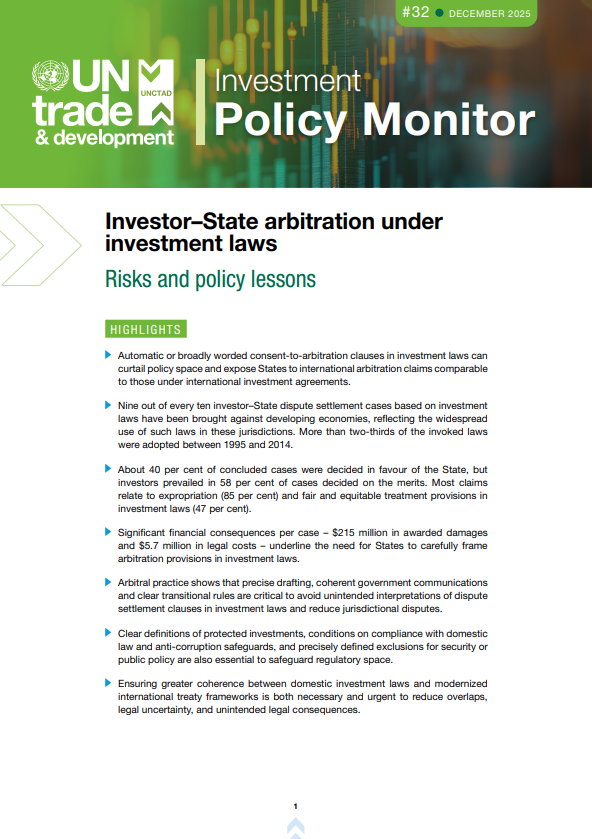
Investment Policy Monitor, Issue No 32: Investor–State arbitration under investment laws: Risks and policy lessons
Arbitral decisions under national investment laws remain far less studied than the extensive jurisprudence on treaty-based investor–State dispute settlement (ISDS) cases. This knowledge gap limits policymakers’ ability to anticipate how arbitral tribunals may interpret domestic provisions, articulate clearly the State’s intent, and avoid unintended consequences. It also creates risks where investment laws interact with overlapping or conflicting obligations in bilateral investment treaties (BITs) and other treaties with investment provisions (TIPs). Broad or ambiguous formulations in arbitration clauses, in particular, may expose States to unexpected claims and restrict their policy space.
Ensuring greater coherence between domestic legislation and modernized international treaty frameworks is therefore both necessary and urgent. As governments pursue investment policy reforms, including the revision, replacement or termination of first-generation treaties, understanding interpretative trends and the implications of specific drafting choices in investment laws has become essential.
Building on the Investment Policy Monitor, No.29 on investment laws trends , this issue focuses on arbitral decisions based on national investment laws. It highlights the potential consequences of certain legislative formulations, and supports reforms that can strengthen dispute-risk management, align domestic frameworks with evolving global standards, and safeguard sustainable development objectives.
Section 1 reviews ISDS cases in which national investment laws were invoked, analysing respondent States and investor home States, arbitration rules applied, outcomes, and economic sectors involved.
The section also examines dispute settlement provisions in investment laws and identifies approaches to strengthen the prevention and early resolution of disputes.
Section 2 distils policy lessons from arbitral practice, showing how tribunals have interpreted key clauses in investment laws, the risks and implications for States, and how these insights can inform the design or reform of national investment legislation.
The IPM concludes by summarizing key takeaways to guide policymakers in reforming investment laws.
Key findings:
- Automatic or broadly worded consent-to-arbitration clauses in investment laws can curtail policy space and expose States to international arbitration claims comparable to those under international investment agreements.
- Nine out of every ten investor–State dispute settlement cases based on investment laws have been brought against developing economies, reflecting the widespread use of such laws in these jurisdictions. More than two-thirds of the invoked laws were adopted between 1995 and 2014.
- About 40 per cent of concluded cases were decided in favour of the State, but investors prevailed in 58 per cent of cases decided on the merits. Most claims relate to expropriation (85 per cent) and fair and equitable treatment provisions in investment laws (47 per cent).
- Significant financial consequences per case – $215 million in awarded damages and $5.7 million in legal costs – underline the need for States to carefully frame arbitration provisions in investment laws.
- Arbitral practice shows that precise drafting, coherent government communications and clear transitional rules are critical to avoid unintended interpretations of dispute settlement clauses in investment laws and reduce jurisdictional disputes.
- Clear definitions of protected investments, conditions on compliance with domestic law and anti-corruption safeguards, and precisely defined exclusions for security or public policy are also essential to safeguard regulatory space.
- Ensuring greater coherence between domestic investment laws and modernized international treaty frameworks is both necessary and urgent to reduce overlaps, legal uncertainty, and unintended legal consequences.