



Publications

Share


Latest publications
World Investment Report 2026: International investment in a turbulent era
IIA Issues Note: Energy transition investment and the transfer of knowledge and skills through better
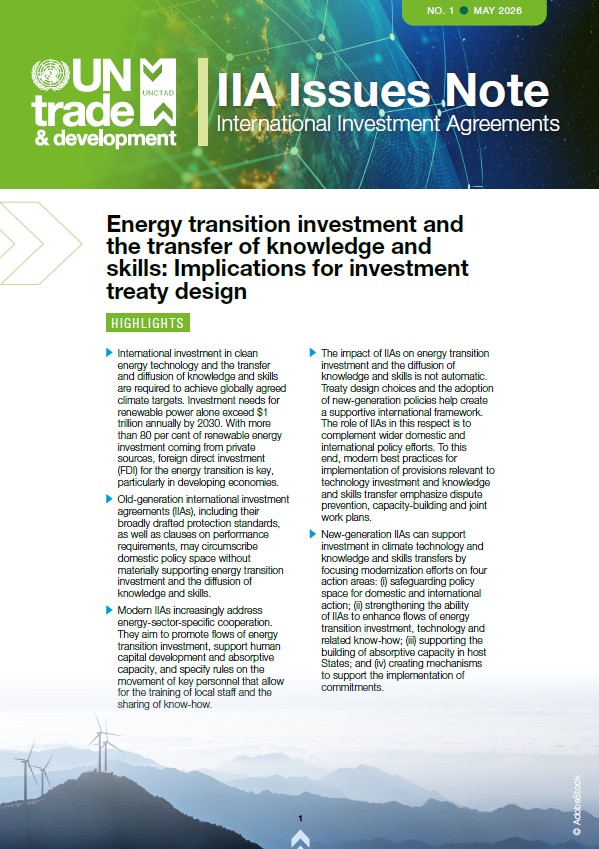
Energy transition investment and the transfer of knowledge and skills: Implications for investment treaty design
International investment will play a major role in financing the global shift to clean energy. But funding alone will not be enough. Countries also need access to technology, know-how and skills to deploy, operate and adapt renewable energy systems.
This report examines how international investment agreements, or IIAs, can support that process through better treaty design.
The scale of the challenge is enormous. Annual investment needs for renewable power alone are expected to exceed $1 trillion by 2030. More than 80% of renewable energy investment already comes from private sources, making foreign direct investment especially important for developing economies.
Yet many older investment treaties were negotiated before climate action became a central policy concern. The report warns that some older treaties may restrict governments’ policy space without significantly supporting clean energy investment or the transfer of knowledge and skills.
Older investment treaties can restrict policy options
Many older IIAs include restrictions on “performance requirements” – measures some governments use to shape how foreign investors operate in the domestic economy. These can include prohibitions from requiring investors to:
- Use local suppliers
- Employ or train local workers
- Transfer technology or know-how
- Meet local content targets – use a minimum amount of locally made equipment or materials
- Export part of their production
Governments have used these measures to support domestic industries, strengthen supplier networks and encourage technology diffusion. But many investment treaties prohibit some or all of these requirements.
The network of in-force IIAs creates more than 4,400 unique bilateral relationships. More than one third (1,578) are governed by treaties prohibiting certain performance requirements.
The report underscores that the impact of performance requirements is mixed. Poorly designed measures can raise costs, discourage investment or fail to create lasting domestic benefits. At the same time, broad treaty bans may prevent governments from using certain policy tools in strategic sectors such as renewable energy manufacturing.
Renewable energy investment disputes highlight risks of older treaty models
The report points to renewable energy disputes as an example of the risks linked to older treaty models. For example, investors launched at least 51 arbitration cases after Spain changed its renewable energy incentive schemes. Publicly available claims exceeded $9.2 billion.
According to the report, countries need enough policy flexibility to adjust energy policies over time as technologies evolve, costs change and climate commitments become more ambitious.
Stronger intellectual property protections may not automatically increase technology transfer
The report also examines intellectual property protections in investment treaties. It highlights the growing use of “TRIPS-plus” provisions – intellectual property protections in IIAs that go beyond internationally accepted standards, including those under World Trade Organization (WTO) rules.
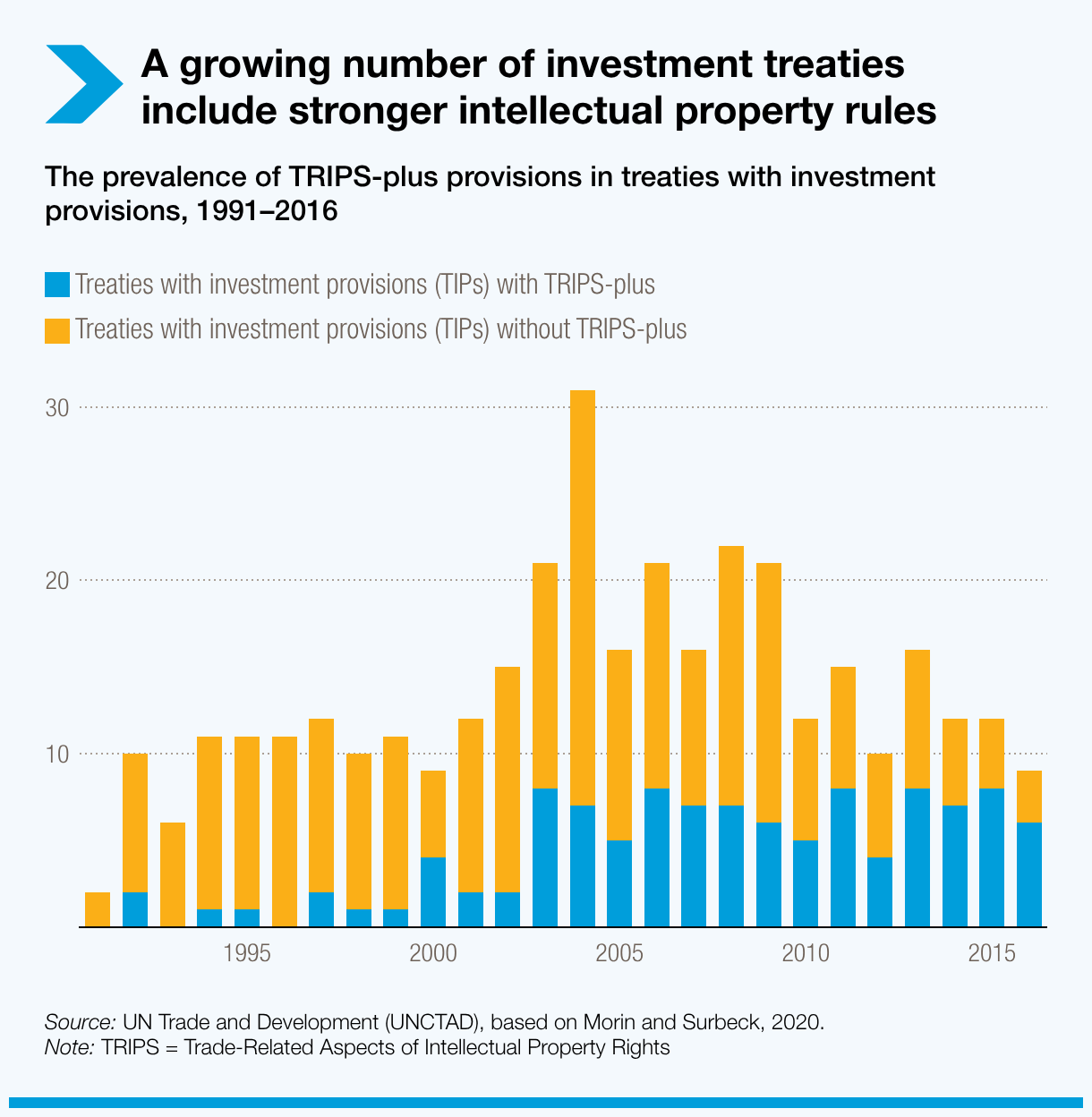
According to the report, stronger intellectual property protection in IIAs won’t by itself necessarily increase climate technology investment or knowledge transfer in most developing countries. Instead, the report argues that treaties should preserve existing safeguards and flexibilities already available under WTO rules and international environmental agreements.
Diffusion of energy transition technology requires domestic capacity
The report emphasizes that foreign investment doesn’t automatically lead to technology diffusion or skills development. Countries also need so-called “absorptive capacity” – the infrastructure, skilled labour, supplier networks and institutions needed to absorb and adapt new technologies. Newer IIAs increasingly include provisions aimed at supporting this process.
New treaty models focus more on cooperation and flexibility
The report says newer investment treaties are moving away from older models that focused mainly on investor protection. Instead, they are increasingly designed to support cooperation, sustainable development and governments’ ability to adapt policies over time.
Some recent IIAs now include:
- More precise investment protection rules and safeguards for governments’ right to regulate
- Detailed provisions on cooperation on climate technology, human capital and sustainable development
- Actionable investment promotion measures for clean energy investment
- Provisions relating to responsible investment that can support technology diffusion
- Chapters on the temporary movement of skilled labour that can support knowledge transfers
- Mechanisms to support treaty implementation and monitoring such as institutional frameworks, detailed work programs and dispute prevention
Investment treaties can support the energy transition
The report concludes that new IIAs can help support the global energy transition if they are designed to facilitate cooperation, technology diffusion and skills development.
It identifies four priorities for modern treaty design:
- Safeguarding policy space
- Supporting flows of clean energy investment and related know-how
- Strengthening domestic absorptive capacity
- Improving implementation and monitoring mechanisms
The report stresses that reformed investment treaties can complement public financing, industrial policies, investment facilitation, skills development and international cooperation to scale clean energy investment and spreading climate technologies.